Analog or IP Cameras for Your Shop in Maputo? A Clear Answer
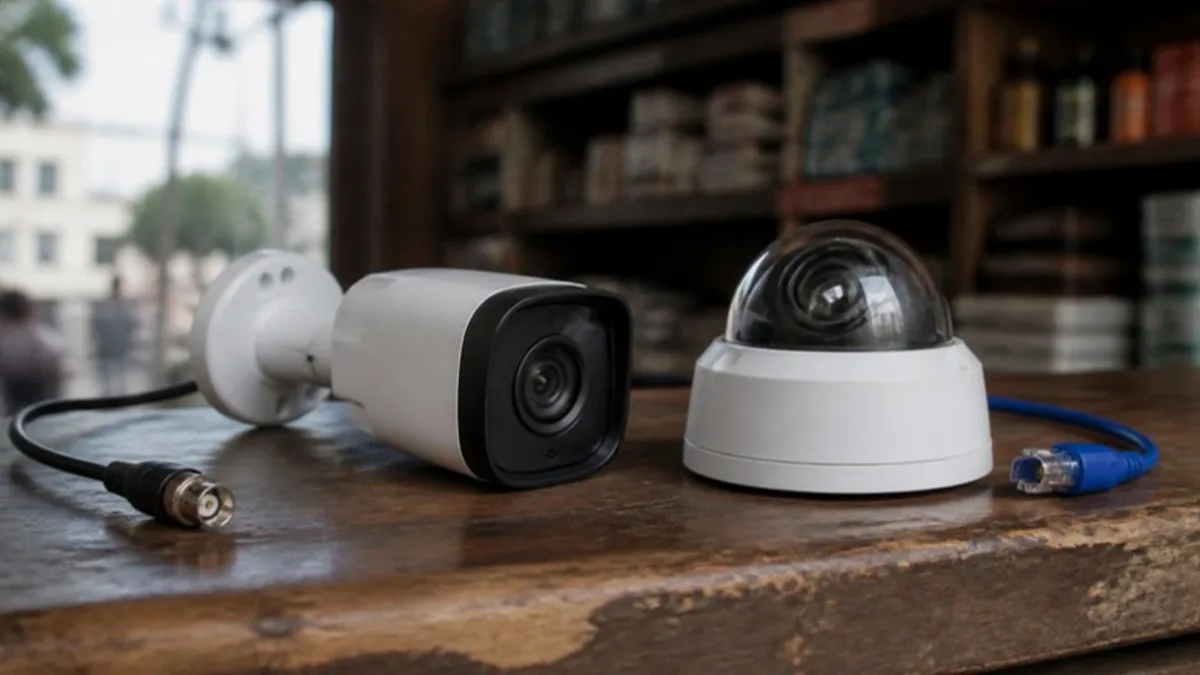
For most small shops in Maputo, an analog HD kit is the sensible first system; IP cameras earn their price when you need more detail or AI alerts. That is the short answer we give at the counter every week. The longer answer depends on your building, your cables and what you expect the footage to prove, so here is how we decide, with the real limits of each option.
The difference, in plain words
An analog HD system (Hikvision calls it TurboHD) sends video over coaxial cable to a DVR, which does the recording. The cameras are simple and tough, and today they record in full HD or better, often in colour at night.
An IP system sends video as data over network cable to an NVR. Each camera is a small computer: it can run AI detection on board, it supports higher resolutions, and it takes its power from the same cable through a PoE switch.
Both record 24 hours a day, both work with the Hik-Connect app on your phone, and both can be installed by us in a day. The choice is about resolution, intelligence, distance and budget.
When analog HD is the right choice
- The budget is tight and the priority is coverage, not detail.
- The building already has coaxial cable from an older system that can be reused.
- Up to 16 cameras in one building, which is most shops, restaurants, clinics and homes.
- Simple layout: cameras within a couple of hundred metres of the recorder.
- You want colour at night: TurboHD ColorVu cameras do this as well as their IP cousins.
Our 8-camera and 16-camera kits are analog HD for exactly these reasons: they cover a typical Maputo shop without any network equipment.
When IP is worth the extra
- You need faces or number plates at a distance: 4 MP and 8 MP IP cameras keep the detail when you zoom into a recording.
- You want smart alerts: AcuSense IP cameras separate people and vehicles from everything else, so a notification at 2 a.m. means something.
- Long cable runs or several buildings: network cable, switches and wireless bridges reach where coax cannot.
- More than 16 cameras, or a plan to grow past that.
- Integration: access control, intercoms and alarms talk to an IP system more easily.
- Remote sites: 4G and solar cameras are IP by nature.
Can you mix both?
Yes. Most Hikvision DVRs are hybrid: they accept a few IP cameras alongside the analog ones. A common upgrade in Maputo is to keep the analog cameras inside the shop and add one IP ANPR camera at the gate or one AcuSense camera on the back wall. When you eventually move to a full NVR, the IP cameras move with you.
Cable, power and distance: the practical limits
Analog HD cameras run on coaxial cable for a few hundred metres at full HD, longer than a single network run, but each camera also needs 12 V power. Either you run a second cable for power or use a combined cable, and the power supply sits near the recorder. On long outdoor runs the cable thickness matters; thin cable from a market stall drops the picture at the far end.
IP cameras use standard network cable, 100 metres per run from a PoE switch. The switch feeds data and power together, so one cable per camera and one UPS in the rack keeps everything alive through a power cut. For more distance you add a switch, a fibre link or a wireless bridge. Our guide to PoE switches covers the power budget and the standards.
What we recommend for typical Maputo shops
- Small shop, café or pharmacy (4 to 8 cameras): an analog HD ColorVu kit, with the entrance camera placed for faces. Add one 4 MP IP camera over the counter if you sell phones, jewellery or medicine, where a clear face matters.
- Supermarket or showroom (12 to 32 cameras): IP, with AcuSense on the exits and the loading bay, and HikCentral or a 32-channel NVR so the manager watches all branches from one screen.
- Warehouse with a yard: IP, because the perimeter needs long runs, night-time AI alerts and sometimes a wireless bridge to the gate house.
- Home or villa: either. Analog HD for a simple four-camera setup; IP when you want a video intercom and smart alerts on your phone.
Frequently asked questions
Do analog cameras record in colour at night?
ColorVu models do, on both analog HD and IP. Standard models switch to black and white with infrared when the light drops. If identifying the colour of a car or a shirt at night matters, ask for ColorVu whatever the system type.
Can I watch analog cameras on my phone?
Yes. The DVR connects to your router and the Hik-Connect app shows live and recorded video from anywhere, the same as with an NVR.
Will my old analog cameras work with a new DVR?
Usually yes. Current Hikvision DVRs accept the common analog formats (TVI, AHD, CVI and the old CVBS), so a new recorder can keep your existing cameras while you replace them one by one.
Which type lasts longer?
Both last for years when the housing is rated for outdoor use and the power is clean. In Maputo the usual killers are heat around the recorder, salt air near the coast and voltage spikes after a cut, so a shaded recorder cabinet, IP66 housings and a UPS matter more than the camera type.
Not sure which one you need?
Send us photos of your entrances or book a free site survey; our post on what happens at the survey explains the visit. Call or WhatsApp 844888222, email vendas@asslda.com, or request a free quote.
Written by the A.S.S. LDA technical team, Maputo.