PoE Switch Meaning: Full Form and How It Powers CCTV
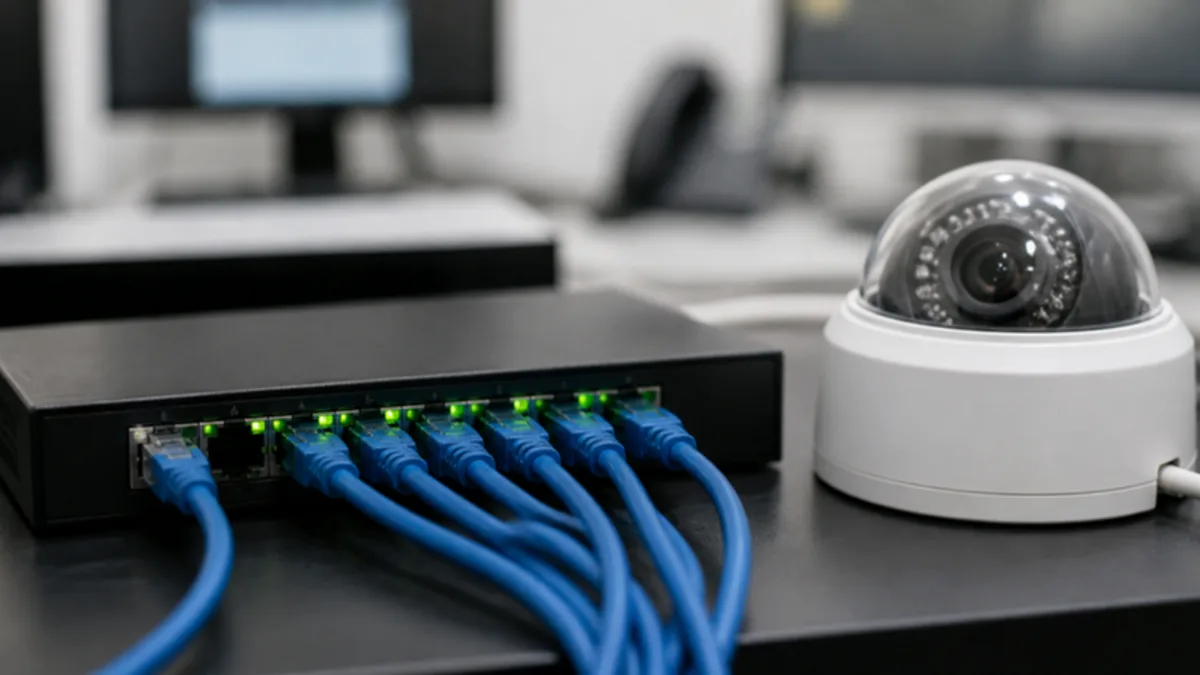
A PoE switch is a network switch that sends electrical power and data down the same Ethernet cable, so an IP camera needs only one cable to work. PoE is short for Power over Ethernet. This guide explains the meaning in plain words, the standards you see on spec sheets, the difference between active and passive PoE, and how to read a switch label before you buy one for a CCTV system in Maputo.
What does PoE stand for?
The full form of PoE is Power over Ethernet. A normal network switch only moves data between devices. A PoE switch does the same and also supplies power on some or all of its ports. The device on the other end, a camera, an access point or a phone, takes both from the one cable and needs no adapter and no socket nearby.
In CCTV this matters because cameras are mounted where sockets are not: under the eaves, on poles, on the corner of a warehouse. With PoE, the electrician has nothing to do at the camera, and all the power comes from one place, the switch, which can sit on a UPS.
The PoE standards on a spec sheet
PoE is defined by IEEE standards. The numbers below are the maximum per port at the switch; the device receives a little less because some power is lost in the cable.
- IEEE 802.3af (PoE): up to 15.4 W per port. Enough for most fixed dome and bullet cameras.
- IEEE 802.3at (PoE+): up to 30 W per port. For cameras with heaters, strong infrared, or motorised lenses, and for many wireless access points.
- IEEE 802.3bt (PoE++), Type 3: up to 60 W per port. For speed dome PTZ cameras and larger devices.
- IEEE 802.3bt, Type 4: up to 90 W per port. For the most power-hungry equipment.
A switch that supports PoE+ also powers 802.3af devices, so newer standards are backwards compatible.
Active PoE and passive PoE
Standard switches use active PoE. Before sending any power, the switch talks to the device and checks that it accepts PoE and how much it needs. If you plug a laptop into an active PoE port, nothing happens to it; the port simply behaves like a normal network port.
Passive PoE sends a fixed voltage, often 24 V or 48 V, all the time, without asking. Some wireless radios and older equipment use it. Passive power can damage a device that does not expect it, so never mix passive injectors with cameras unless the camera's datasheet allows it. When in doubt, choose a switch that follows the IEEE standards.
PoE budget: the number most people miss
Every PoE switch has a total power budget, the most it can deliver across all ports at once. An 8-port switch with a 65 W budget cannot give 30 W to every port; eight cameras at about 6 W each are fine, two PTZ cameras are not. Add up the power of every device you plan to connect, leave headroom for growth and for infrared at night, and compare it with the budget printed on the label. Our older guide on choosing a PoE switch for CCTV walks through a full example.
What else is on a CCTV switch label
- Number of PoE ports and uplink ports: the uplink connects the switch to the recorder or the main network, often at gigabit or through fibre.
- Managed or unmanaged: a managed switch lets you see the power on each port and restart a camera remotely. Unmanaged is simpler and fine for small systems.
- Long-range mode: some CCTV switches can push a port beyond the usual 100 metres by lowering the speed, which is enough for a camera at the far end of a yard.
- Surge protection: important in Mozambique during the storm season, especially for outdoor cable runs.
PoE switch, NVR with PoE, or injector?
Small systems often use a recorder with built-in PoE ports: four or eight cameras plug straight into the NVR. Larger systems use a separate PoE switch, which allows more cameras, longer layouts and a cleaner rack. A PoE injector powers a single device from a normal socket and is useful for adding one camera to an existing network. See our network equipment and our network and IT infrastructure page for what we install.
Frequently asked questions
What does PoE mean in CCTV?
PoE means Power over Ethernet. The camera receives power and sends video over a single network cable connected to a PoE switch or a recorder with PoE ports, so no separate power supply is needed at the camera.
How far can a PoE cable run?
Up to 100 metres between the switch and the device with good Cat5e or Cat6 cable. For longer runs you can use a long-range mode on a CCTV switch, a PoE extender, a second switch, or fibre.
Can a PoE switch damage a normal computer?
Not an active PoE switch that follows the IEEE standards. It only sends power after the device asks for it. Passive PoE injectors are different and should only be used with equipment that is designed for them.
Is a PoE switch the same as a CCTV switch?
A CCTV switch is a PoE switch built for cameras, usually with a bigger power budget, surge protection and sometimes a long-range mode. Any standard PoE switch can power a standard IP camera.
Get the network right
We design, supply and install PoE networks for cameras across Mozambique. Message us on WhatsApp +258 84 488 8222 or get a free quote.
Written by the A.S.S. LDA technical team, Maputo.